
Leather Furniture and Pets: What Actually Holds Up, and What to Watch For
La-Z-Boy Southeast | May 29, 2026
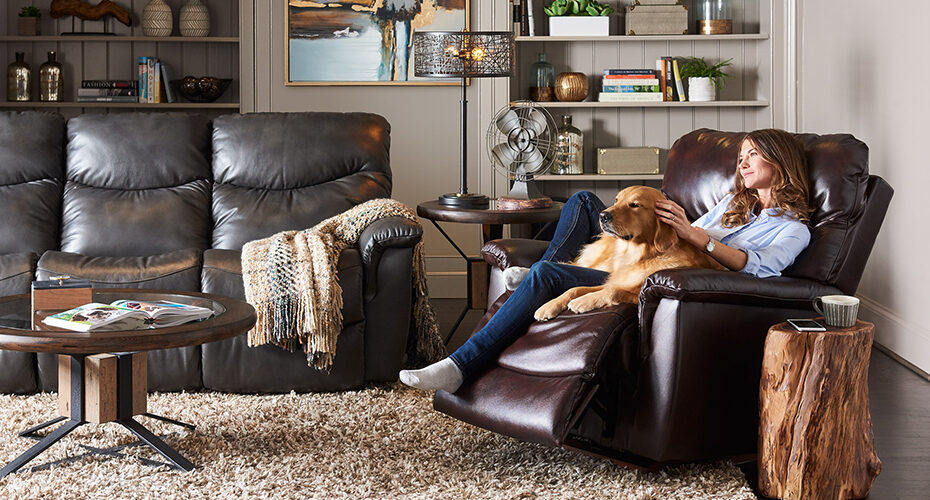
Most of our pet-owning customers arrive with the same question, phrased one of two ways: Will my dog destroy a leather sofa? or Won’t my cat’s claws shred it in a week? They wonder whether leather furniture is great for pets or if it should be avoided entirely.
The honest answer in both cases is: probably not, if it’s real leather and you take a few simple measures. But “probably not” deserves the longer explanation, because there’s a meaningful difference between how leather and fabric behave around animals — and a couple of places where leather doesn’t automatically win.
Where leather genuinely outperforms fabric for pet households
Claws slide instead of catching. This is the biggest practical difference. A cat hopping onto a fabric sofa can hook a single claw into the weave and pull a thread out across two inches before they even land. The same cat on top grain or full grain leather usually finds nothing to grip — the surface is uniform and dense, and claws tend to skate across it. Determined scratching can still leave marks, but the everyday “I just jumped up” claw contact that ruins fabric upholstery does much less to leather.
Pet hair brushes off instead of weaving in. Fabric, especially anything with a nap, holds onto hair tenaciously. Vacuuming gets most of it; lint rollers get more; but a fabric sofa in a house with a shedding dog never quite gets clean. Leather releases hair with a wipe of a dry cloth. This single difference is what convinces a lot of long-haired-breed owners to switch.
Smells don’t soak in. Fabric absorbs the oils that carry pet odor — even when it doesn’t look dirty, it can start to smell like the dog over time. Leather has no fiber for those oils to seep into. The surface either wipes clean or it doesn’t, but there’s no slow accumulation of smell.
Accidents are recoverable. Urine, vomit, or muddy paws on fabric usually means stain remover, a deep clean, and crossing your fingers. The same accident on leather, if you get to it within a few minutes, usually means a damp cloth and a follow-up wipe with mild soap and water. The keyword is quickly — leather is forgiving but not magic, and dried-on pet urine is acidic enough to damage the finish if it sits.
Dander stays on the surface. This matters for anyone in the household with allergies, especially seasonal or pet-specific ones. Fabric holds dander down at the fiber level where vacuums can’t fully reach it. Leather doesn’t.
Where leather for pets doesn’t win automatically
We’d rather you hear this from us than discover it later.
Real leather is not puncture-proof. It is much more resistant than fabric, but a large dog jumping up repeatedly, an under-trimmed claw, or a cat that has decided your sofa is a scratching post can absolutely leave marks. The marketing claim you sometimes see — that genuine leather is “too thick to be punctured” — is overstated. Top grain and full grain leather are tough, but they’re not armor.
Edges and corners are the weak points. If a pet routinely jumps from the same spot, the leading edge of the seat cushion or the front of the armrest is where wear will show first. A throw or runner across the landing spot solves it.
Pet accidents need fast cleanup. Leather is forgiving for the first ten minutes after a spill or accident. After that, the acid in urine or the oils in vomit can start working on the topcoat. If you have a puppy in training or an aging pet, keep a leather-safe wipe within reach of the most-used pieces.
Leather doesn’t hide things. A small claw mark on a busy patterned fabric vanishes into the print. The same mark on a solid black leather sofa is visible. Leather looks better longer overall, but when something does happen, you’ll see it.
A note about claws and trims
The single most effective thing pet owners can do to protect leather furniture costs nothing: keep claws trimmed. Most pet damage to leather furniture isn’t from a one-time catastrophe — it’s the slow accumulation of hundreds of small contacts from over-grown claws. A regular trim schedule does more for upholstery longevity than any product on the market.
How our pieces are built (and why the construction matters here)
Most of our leather furniture uses top grain or full grain leather on every seating surface — seats, backs, and arm tops — with color-matched performance materials on the sides and backs of the piece. The performance materials are tough, easy to wipe down, and not noticeably less pet-resistant than the leather itself. For pet households, this construction holds up well in practice.
If you’d rather the entire piece be wrapped in top grain or full grain leather — sides and backs included — that’s available as a premium build. Some pet owners prefer it for aesthetic consistency. It’s a choice, not a necessity.
We do not carry bonded leather. It performs poorly under normal use and worse under pet use — the top coat fails within a few years and there’s no recovering it. Our bonded leather vs. genuine leather article covers the full story.
The Paws & Claws Warranty
For pet owners who want extra coverage, La-Z-Boy offers a Paws & Claws Warranty that’s available with most of our leather pieces. It runs five years and covers damage from claws, teeth, and pet accidents — submit a photo, and qualifying damage is repaired or the piece replaced. It’s not a substitute for routine care, but for households with a young, large, or particularly active animal, it’s worth asking about. Your sales associate can walk through what’s covered.
See it in person
The honest test of any pet-friendly furniture is sitting on it and looking closely at the construction. We have locations across NC, SC, and GA, and our free design consultations are the easiest way to see the leather lineup. You can also browse the current La-Z-Boy leather collection online.
Related reading:
- How to Clean and Care for Leather Furniture
- Bonded Leather vs. Genuine Leather: What 50 Years of Selling Has Taught Us
- Leather vs. Fabric: Why We Keep Recommending Leather
- Everything You Need to Know About Leather Recliners